
Sagehen Meadows: My Favorite Place on Earth to Photograph Wildflowers
May 16, 2026
By Scott Thompson | Scott Shots Photography
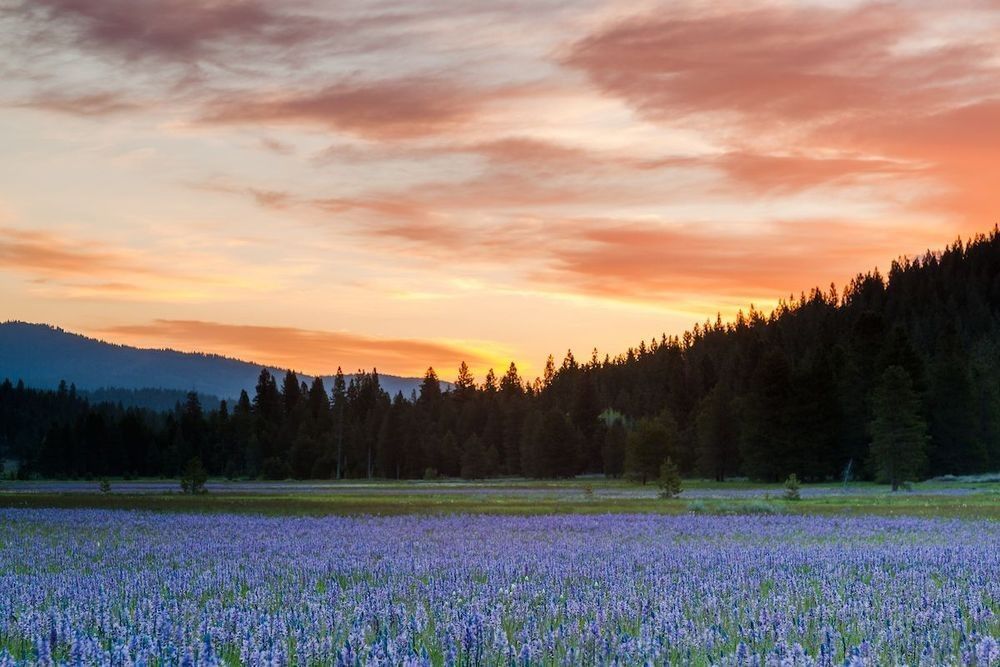
There's a meadow north of Truckee that I keep coming back to, just about every single spring. Some years the blooms are modest. Some years I drive out there and find the whole thing is still underwater from snowmelt, or the camas flowers have already been beaten down by a late-season snow. But some years — the good years — Sagehen Meadows turns into something that looks almost unreal. A solid blanket of deep purple Camas wildflowers stretching across the meadow floor, so dense and vivid that from a distance it honestly looks like a purple lake sitting in the middle of the Sierra Nevada.
I first visited Sagehen Meadows shortly after moving to Truckee, on a hike with my family and some friends. I remember standing at the edge of the meadow and thinking: I have to come back here with a camera. In 2005 I did exactly that, shooting the Camas bloom on my Canon EOS 3 film camera. It was an incredible year for the flowers, and I was happy with the images I got — but once I made the switch to digital, I was determined to capture that purple sea again at a resolution I could print big. I've been going back ever since.
This is my attempt to share everything I know about photographing Sagehen Meadows — the timing, the access, the gear, the technique, and the little details that can make the difference between a forgettable snapshot and a photograph you want to hang on your wall.
What Is Sagehen Meadows?
Sagehen Meadows sits just southwest of Stampede Reservoir, a bit north of Truckee, California along the Sagehen Creek drainage. The area is part of the Sagehen Experimental Forest, a 9,000-acre research reserve managed by UC Berkeley — which means it's protected, relatively uncrowded, and in genuinely beautiful condition. The creek itself eventually flows east to Stampede Reservoir, and the meadow sits in the broad, wet floodplain along its course.
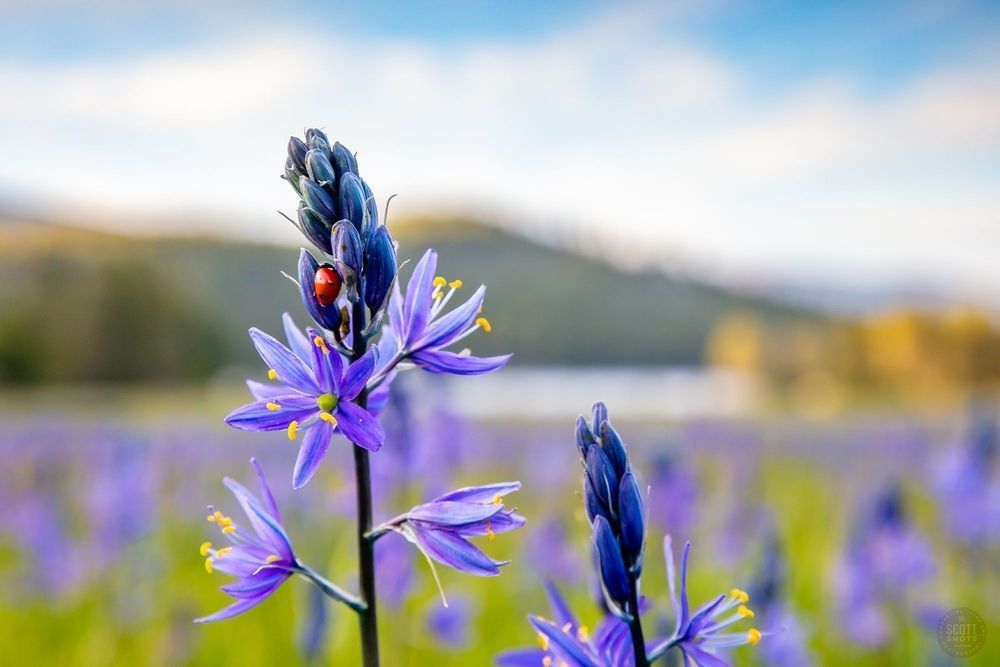
The star attraction from a photography standpoint is the annual bloom of Camas (Camassia), a striking purple-blue wildflower that thrives in wet, boggy meadow environments. Here's something worth knowing — and something I've had to defend more than once when people have looked at me like I was making it up: Camas are not actually lilies. I know. They look like lilies. People have called them “Camas lilies” for generations. But the science has moved on. Camas (Camassia) was historically placed in the lily family (Liliaceae) back when that family was broadly defined to include most lilioid monocots. Since then, DNA and biochemical studies conducted by the Angiosperm Phylogeny Group — the international body of botanists that determines plant classification — have reassigned the entire Camassia genus to the Asparagus family (Asparagaceae), subfamily Agavoideae. That puts Camas in the same family as asparagus, agave, and yucca — not lilies. The NC State Extension Gardener Plant Toolbox, one of the most widely used horticultural references in North America, now lists Camas simply as a member of the asparagus family, with accepted common names of Camas, Quamash, and Wild Hyacinth. No “lily” anywhere. So the next time someone corrects you at the trailhead, you can correct them right back — with sources.
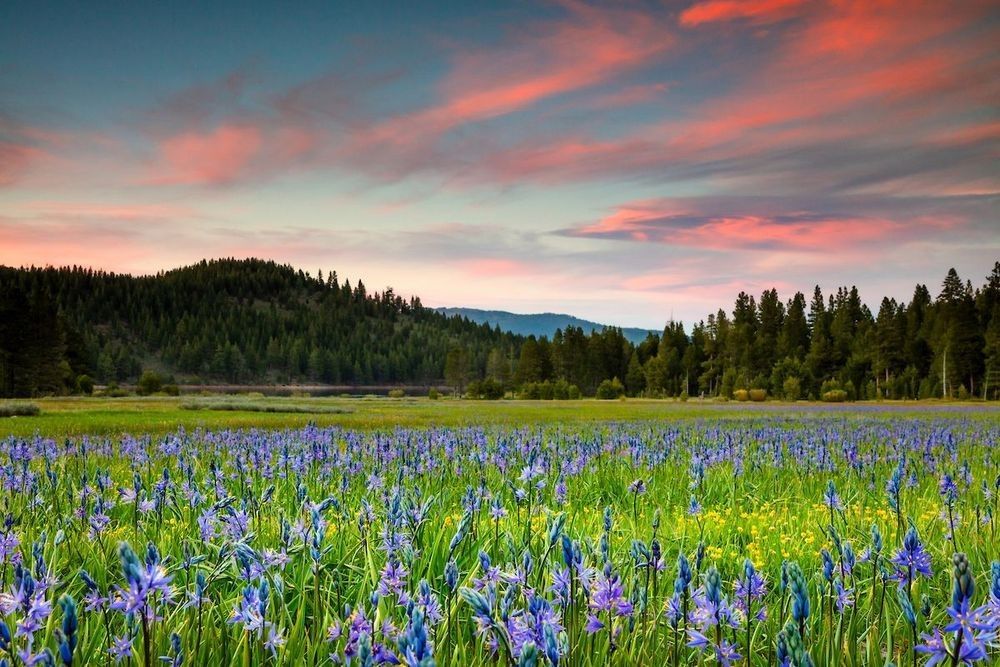
But Camas aren't the only show in town. Depending on the timing of your visit, you might also find American Bistort, yellow Buttercups, Mule Ears, and a variety of other Sierra Nevada wildflower species. I've had years where I timed it just right and captured Buttercups and Camas in the same frame — the Buttercups tend to bloom a bit earlier and usually start fading right as the Camas peak, so getting both is a lucky window.
Beyond flowers, the meadow is also remarkable for its wildlife. I've encountered birds, deer, and a whole lot of very enthusiastic mosquitoes. More on that in a moment.
Timing: When to Go
Peak Camas bloom at Sagehen Meadows typically falls somewhere in the late May to early June window — but this varies significantly from year to year depending on snowpack and spring temperatures.
In a light snow year, the flowers can be peaking before Memorial Day. In a heavy snow year, the dirt access roads may still be snowed in or muddy through late May, and the bloom can push all the way into mid-June. My general approach is to keep an eye on the snowpack throughout winter and start scouting in mid-May. The first drive-by of the season is usually a scouting mission — checking road conditions and flower status — before committing to a full early-morning shoot.
One thing worth knowing: the Camas season is short. We're talking a window of roughly two to three weeks from first bloom to peak to fade. And a late spring snowfall can damage the petals and shorten that window even further. I've shown up after a couple inches of unexpected snow and found flowers that were wilted and beaten down, far less photogenic than they'd been just days before. The meadow is worth visiting even out of Camas season — it's still beautiful in summer and fall — but if you're chasing the purple bloom, timing is everything.
Getting There: Three Ways In
The meadow itself is located at approximately 39.4497° N, 120.1805° W, just southwest of Stampede Reservoir. You can drop those coordinates directly into your navigation app, or use this Google Maps link as a reference point for planning your route.
The Sagehen Creek Trailhead (Easy, No 4x4 Needed)
The most well-known and accessible entry point is the Sagehen Creek Trailhead off Highway 89, located at 39.4342° N, 120.2050° W — about 7 miles north of the Prosser Dam Road roundabout near Truckee. Watch for the Sagehen Creek bridge — the dirt parking area is immediately on the right after you cross it. There are no signs marking the trailhead, so watch your odometer and don't worry if you overshoot it on the first pass. Traffic moves fast on 89.
From the parking area, it's roughly a 2.5-mile hike in to the meadow along the Lower Sagehen Creek Trail. The trail follows the creek through pine forest before opening into the meadow. This route is suitable for hikers of all levels — no 4WD, no special vehicle required. The trail is maintained and well-traveled during wildflower season.
The 4x4 Road (My Preferred Route)
I almost always go in via a long dirt road that accesses the meadow from the other direction, off of Dog Valley Road. This route lets me park close to the meadow itself instead of hiking 2.5 miles each way — which matters a lot when you're arriving at 3 or 4 in the morning for sunrise, or staying until well after dark for night shots.
The honest caveat: this route has a lot of forks in the road and can be difficult to navigate the first time without someone who's been there before. A true 4WD vehicle is recommended, especially when the road is wet. I've driven it dozens of times and I still occasionally second-guess myself at certain junctions. If you know someone familiar with the Dog Valley Road approach, go with them the first time. If not, the Sagehen Creek Trailhead hike is the safer and more straightforward option.
By Boat from Stampede Reservoir (The Unexpected Option)
Here's one most people haven't thought of — I've actually boated to Sagehen Meadows. Since the meadow sits on the western edge of Stampede Reservoir, you can beach a boat on the shoreline and walk in from there. It's only about a 10-minute walk from where you can beach the boat to where the Camas actually bloom. It's a genuinely fun and different way to experience the area, and if you happen to have a boat and want to combine a day on the water with wildflower photography, it's hard to beat. Just be aware that water levels at Stampede can vary significantly depending on the year, which will affect how close to shore you can get.
Camera Gear and Settings
I shoot Sagehen Meadows at all times of day and in all conditions, and the gear I reach for changes depending on what I'm after.
For daytime wildflower photography, I currently shoot with a Canon R5 Mark II, which is a significant upgrade in resolution, dynamic range, and high-ISO performance from the Canon bodies I've used at Sagehen over the years. I've photographed this meadow on multiple Canon cameras and lenses going back to a film body in 2005, upgrading every few years — the location has outlasted every camera I've owned. Right now I pair the R5 Mark II with a 24-105mm lens for most of the landscape and meadow work. The flexibility of that zoom range is really useful in a meadow environment — you can go wide to show the sweep of the whole scene with Stampede Reservoir in the background, or tighten up to isolate a cluster of flowers or a single ladybug on a petal.
For aperture, I typically shoot around f/18 to f/22 when I want sharp focus across a large area of flowers and into the background. A small aperture gives you that deep depth of field that really captures the sense of a meadow full of blooms. That said, for close-up or macro-style shots of individual flowers, I'll open up wider to get a softer, more isolated look.
ISO I try to keep as low as possible — ISO 100 to 400 — to maintain clean image quality for large print sizes. With the aperture that small, shutter speeds can get slow, which brings me to one of the most important tools in the bag out there: a tripod is absolutely essential.
Filters matter here. I regularly use two filters at Sagehen:
- A polarizing filter for daytime shots. It deepens the blue of the sky, cuts glare off the wet petals and any standing water in the meadow, and generally makes the colors pop in a way that's hard to replicate in post-processing. If you're only going to carry one filter, carry a polarizer.
- Graduated neutral density filters (I often use two stacked) to darken the sky and balance the exposure between the bright sky and the darker meadow foreground. This is especially important at sunrise and sunset when the contrast between the glowing sky and the shadowed meadow is at its most extreme.
One important field reality: wind is your enemy at Sagehen. Even a light breeze will move the flowers during a long exposure and turn your carefully planned shot into a blurry mess. I've had sessions where I sat and waited for long stretches between gusts, shooting during the brief calm windows. Patience is part of the technique.
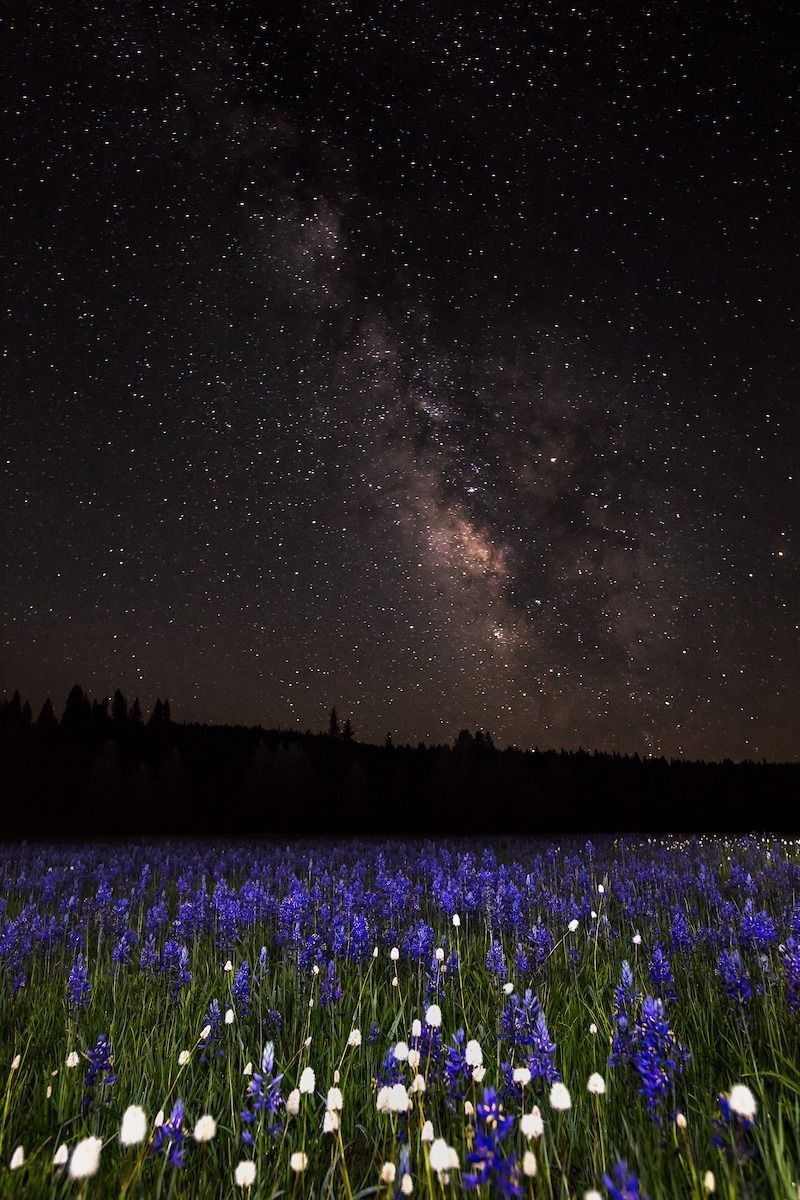
For Milky Way and night photography, the approach is completely different. I switch to a fast wide-angle lens — something in the 15-25mm range — and open up to the widest aperture possible (f/2.8 or wider if available). ISO goes way up, typically ISO 1600 to 3200, and exposures run 20-25 seconds to capture the stars without them trailing.
One technique I love for night shots at Sagehen: using a headlamp to light paint the foreground flowers during the long exposure. The Camas look incredible lit from below against a star-filled or Milky Way sky. I've shot this image multiple times and it remains one of my personal favorites from the meadow — and one of the most striking images I've ever taken anywhere. The key is using the headlamp sparingly and from the right angle so you're illuminating the flowers, not washing them out.
Comfort and Preparation
A few practical notes that come from years of learning the hard way:
Bug spray is non-negotiable. Sagehen Meadows is a wet, boggy environment and the mosquitoes can be genuinely aggressive, especially in the early morning and at dusk. I've sat in that meadow collecting mosquito bites while waiting for the right light, and I can tell you: a good DEET-based repellent is worth every cent. Apply it before you get out of the car.
Water-resistant footwear. Even when the meadow looks mostly dry, you will find wet spots. The ground in and around the meadow can be spongy and marshy, and if you're shooting at the edges of the more flower-dense areas, you may be stepping into ankle-deep water. I've been surprised by that more than once. Water-resistant hiking shoes or snow boots make the whole experience significantly more enjoyable.
Bring a headlamp — for sunrise, sunset, and night shoots. If you're arriving before dawn for sunrise (which I often do, pulling up to the meadow while it's still pitch black), a headlamp is essential just to safely navigate the area before the light comes up. The same goes for staying through sunset — once the sun drops, it gets dark fast, and the dirt road and trail have no lighting. And of course, if you're hanging around for stars or the Milky Way, a headlamp doubles as your light painting tool for the foreground flowers. It's one of those pieces of gear I always have in my bag and almost always end up needing, no matter what time of day I'm shooting.
Weather apps and sunset forecasting. I've been burned (in both directions) by sky forecasts. One evening, the SkyFire app was calling for a completely unremarkable sunset, and what actually happened was one of the most beautiful sunsets I've ever photographed at Sagehen — the sky just ignited. Don't always trust the apps. If clouds are building and the light is doing interesting things, stick around. You might be very glad you did.
Water and snacks. If you're hiking in from the Sagehen Creek Trailhead, you're looking at a 5-mile round trip. Bring enough water, especially on warm late-spring days when the sun can be intense.
What to Shoot
Beyond the obvious wide Camas meadow shot, here are some of the compositions and subjects I've found most rewarding at Sagehen over the years:
The purple lake effect. When the Camas are at peak bloom and you find the right elevated vantage point, the entire meadow floor looks like a purple lake. Getting slightly above the flowers — on a small rise or hillside at the meadow's edge — and shooting across them toward the mountains or Stampede Reservoir in the distance captures this effect beautifully.
Close-up and macro work. Individual Camas flowers are gorgeous up close. I've shot compelling close-ups of single flowers, flower clusters, and — one of my favorite accidental discoveries — a ladybug on a Camas petal. The detail and color in a well-executed macro shot of these flowers can be just as powerful as the wide landscape view.
Sunrise with color. I've woken up at 3 a.m. many times to make the drive out to Sagehen for sunrise. Not every sunrise pays off, but when it does — when the eastern sky turns orange and pink and the purple meadow is lit in that early warm light — it's genuinely one of the most beautiful sights in the Sierra Nevada.
Sunset. The sunsets at Sagehen can fire off even when the forecast says they won't. The west-facing meadow has a great view of the sky as it transitions after the sun drops, and the combination of sunset light on the purple flowers is something I keep chasing year after year.
Milky Way above the Camas. This one requires planning around the lunar calendar (you want a new moon or moon-down window) and waking up in the middle of the night, but the results are worth it. Milky Way photography at Sagehen Meadows during Camas bloom season is as good as it gets for astrophotography in the Truckee area. Headlamp light-painting the foreground flowers takes this from a nice sky shot to something genuinely special.
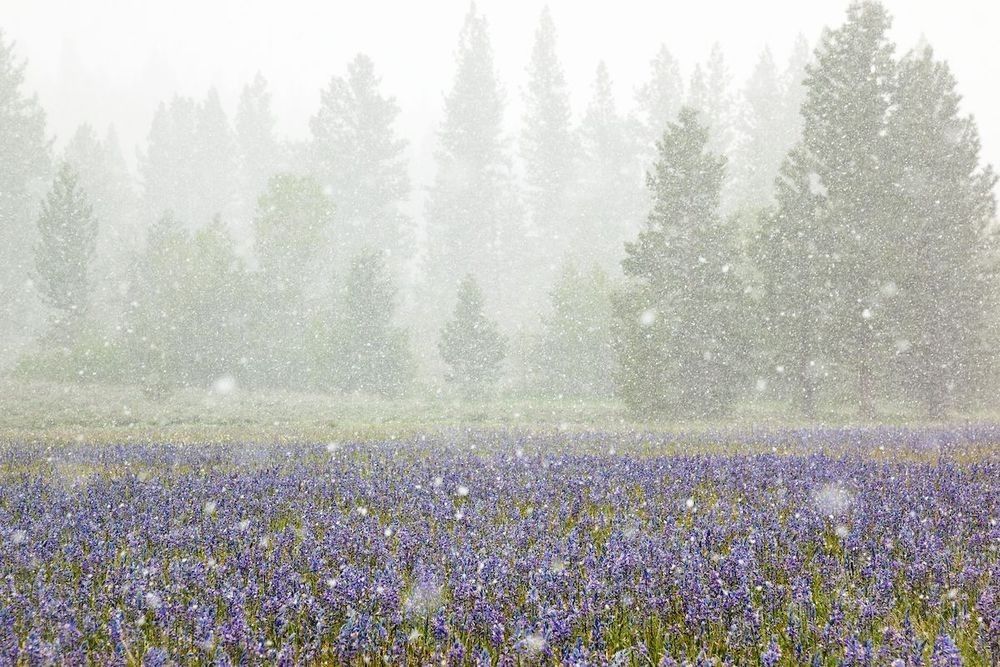
Snow on the Camas — if you're lucky enough. One of my all-time favorite Sagehen shots came from a visit I almost didn't make. I drove out to the meadow during an unexpected late spring snowstorm, arriving right as the snow was starting to fall heavily. The scene was absolutely magical — purple Camas blooms dusted with fresh white snow, the kind of image that stops people in their tracks. But the window was brutally short. About 30 minutes after I arrived, the weight of the accumulating snow started crushing the flowers flat and they were no longer photogenic. The whole thing was over in half an hour. That experience taught me that some of the best shots at Sagehen come from showing up in conditions that seem wrong on paper. If it's snowing during Camas season, consider driving out — you might get something nobody else has.
A Final Note
I've been photographing this meadow for over twenty years now, and it still surprises me. Some years I drive out fully expecting a great shoot and come home with nothing I love. Other years I'm just scouting, not expecting much, and the light does something I didn't see coming and I end up with one of my favorite images ever.
That's the thing about Sagehen. It rewards patience, persistence, and showing up — especially when the conditions seem marginal. The best photos I've taken there weren't the result of perfect planning. They were the result of being there.
If you go, I hope you find the purple lake.
— Scott
Update — May 2026: I went back to Sagehen just as this blog post was going live, and the meadow did not disappoint. The bloom was running a little early this year, and I arrived at sunset to find the Camas at or very near peak. Then the sky ignited. But the real surprise was in the foreground — a single rare white Camas flower standing perfectly centered among the purple sea, almost as if it had been placed there. White Camas are a natural genetic variant and genuinely uncommon to find, let alone to find centered in your composition at the moment the sky turns pink and red. I've been photographing this meadow for over twenty years. It still surprises me.
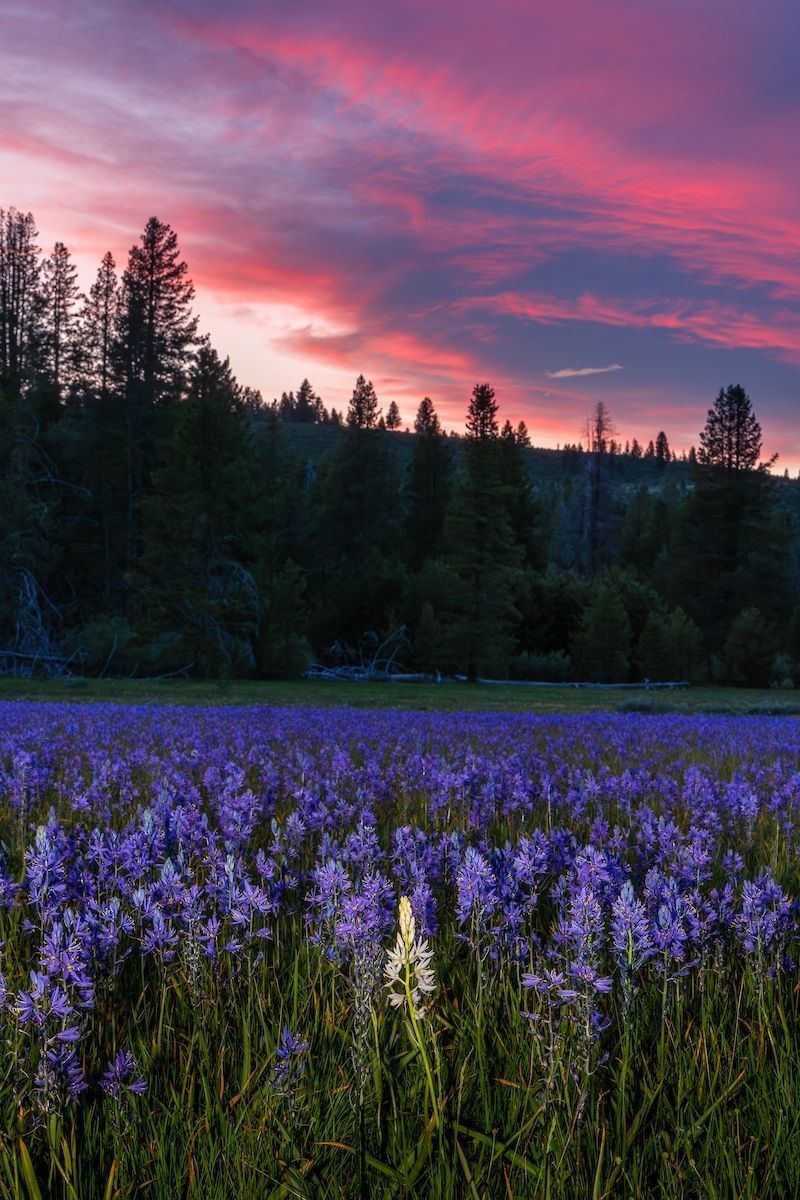
“Sagehen Meadows Sunset 11” — A rare white Camas flower stands centered among a sea of vibrant purple blooms, beneath a dramatic sunset sky of deep pink and purple clouds. Fine art prints available here →
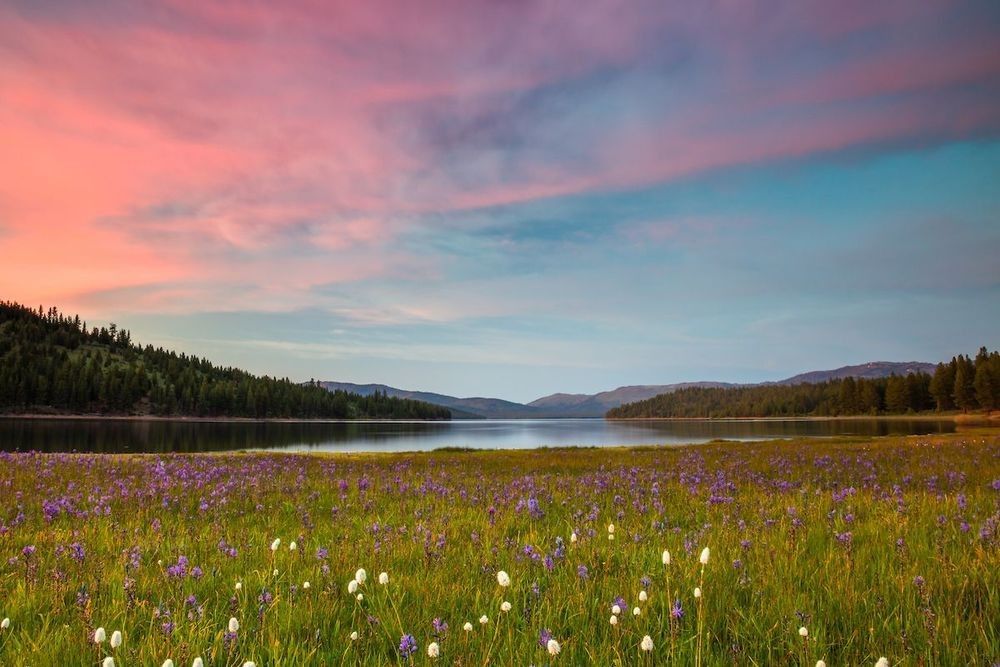
Photo Gallery — Sagehen Meadows
Fine art prints of Sagehen Meadows — including Camas wildflowers at sunrise, sunset, and under the Milky Way — are available at truckeetahoephotos.com. All photographs © Scott Thompson / Scott Shots Photography.