Mono Lake's Tufa Towers: What I Found on a Last-Minute Stop on Highway 395
Jul 18, 2026
I almost didn’t stop. I was on Highway 395, northbound, heading home to Truckee after a fishing trip and a visit with my brother in Mammoth Lakes. The turnoff for Mono Lake’s South Tufa area was coming up fast, and every practical instinct was telling me to just keep driving. Home was a couple of hours away, it was midday, and midday light in a high desert basin is nobody’s idea of prime photography conditions.
I turned anyway. I’d photographed Mono Lake before — a dedicated sunset session back in 2010 that produced some of my favorite images from that era — and something about being right there on the road, with a camera in the truck and a clear sky with white puffy clouds overhead, made it impossible to drive past. I had the gear. I had time. “I’ll come back when the light is better” is the most reliably broken promise in photography.
I spent just over an hour at the South Tufa area. I came away with some of the most striking images I’ve made in recent memory — in conditions I wouldn’t have planned for, at a time of day I normally avoid for landscape photography. Here’s what the place is, what I found when I got there, and everything I’d want you to know before you make the same stop.
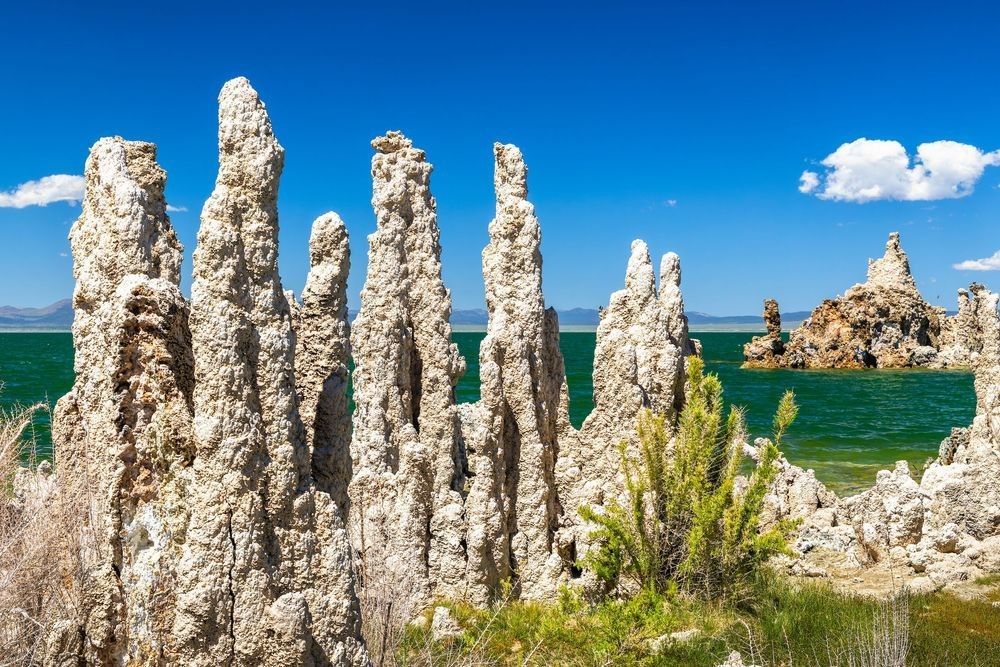
A dense cluster of tufa spires at Mono Lake’s South Tufa area — these calcium carbonate formations spent thousands of years growing entirely underwater before the lake level dropped. Click the image to view print options.
What Are the Tufa Towers?
If you’ve never been to Mono Lake, the tufa towers are the formations that make it instantly recognizable — eerie, knobby limestone spires rising out of the water and along the shoreline, looking like something between ancient ruins and alien geology. They’re unlike anything else in California, and honestly unlike most things anywhere.
Here’s how they form. Calcium-rich freshwater springs bubble up from the lakebed, and when that calcium meets the carbonate-rich water of the lake, it crystallizes into limestone. Over thousands of years, those deposits accumulate into the columns and spires you see today. Every one of these formations grew entirely underwater — and that’s the detail that makes the whole story complicated.
You wouldn’t have seen any of these towers above the waterline before 1941. That’s when the City of Los Angeles began diverting the streams that feed Mono Lake to supply the city with water. As the lake level dropped dramatically over the following decades, formations that had been quietly growing in the dark for millennia were suddenly exposed to the air. What looks like a primeval, ancient landscape is also, in part, the result of a water rights decision made in the middle of the last century. The Mono Lake Tufa State Natural Reserve was established in 1981 specifically to protect the formations and the ecosystem. Partial restoration of stream flows began in the 1990s — but the lake is still well below its historical level.
The lake itself is about two and a half times saltier than the ocean and highly alkaline — conditions that support almost no fish, but sustain enormous populations of brine shrimp and alkali flies, which in turn feed some of the largest concentrations of migratory birds in the American West. The more you learn about Mono Lake, the stranger and more remarkable it gets.
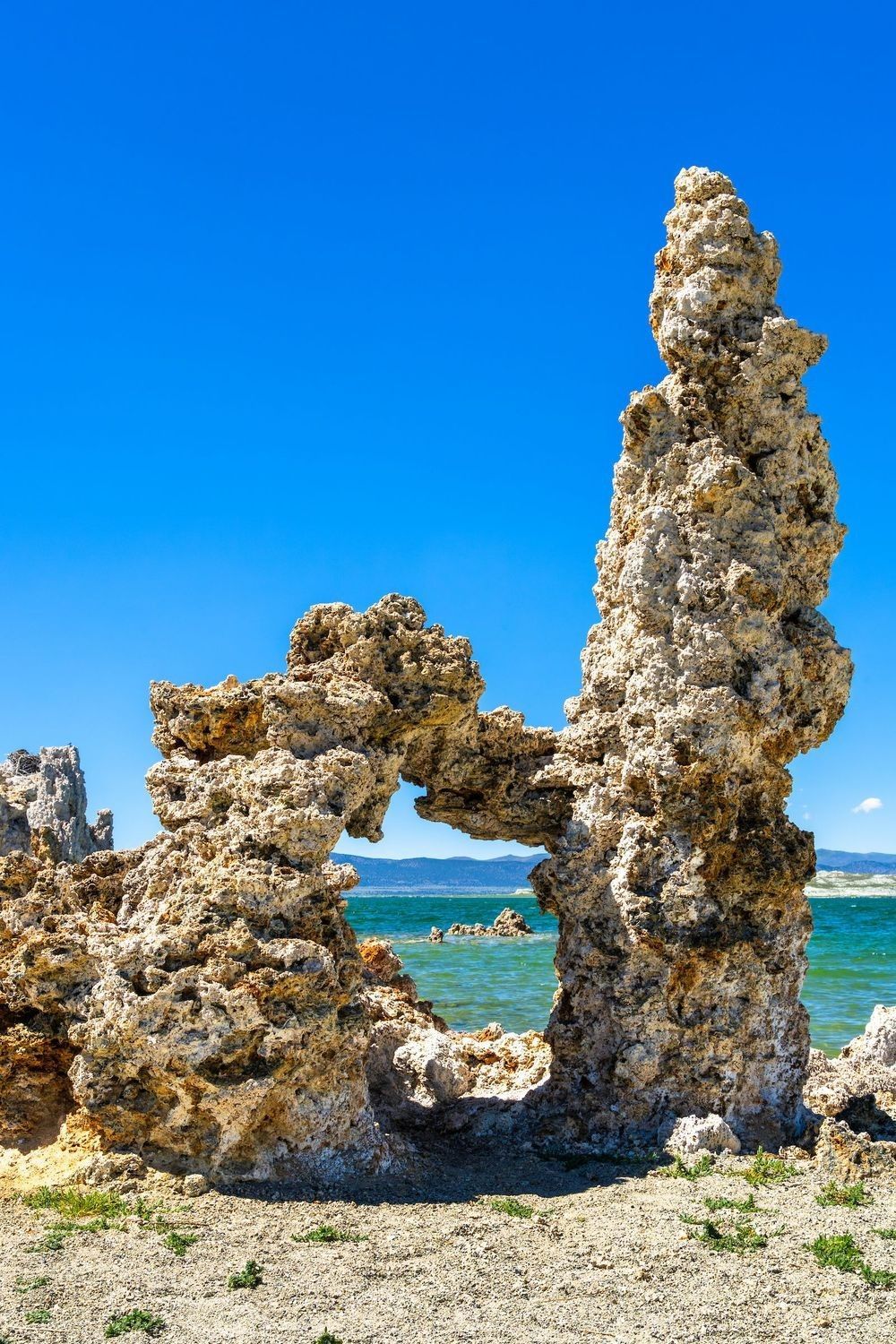
Weathered tufa formations join to create a natural arch, framing a view through to Mono Lake’s aqua-green water and the distant mountains beyond. Click the image to view print options.
The South Tufa Area: The Main Attraction
The South Tufa area has the highest concentration of tufa formations anywhere on the lake, which is why it draws the most visitors. There’s a large parking area accessible by a well-maintained dirt and gravel road — any vehicle can handle it, no four-wheel drive needed. The entrance fee is three dollars, collected at a kiosk that accepts credit cards. I didn’t see a cash option, so make sure you have a card with you. From there, boardwalks and well-worn trails bring you right out among the formations at the water’s edge.
When I was there, a pair of volunteer rangers had set up a spotting scope aimed at an active osprey nest and were inviting visitors to take a look. That kind of thing elevates a visit — you leave understanding something about the place, not just having walked through it. There’s also excellent interpretive signage throughout the area explaining the geology of the tufas, the history of the lake’s water levels, and the ecology of the ecosystem. It’s a genuinely educational stop, and accessible enough that I watched families with young kids exploring comfortably. The South Tufa area isn’t a demanding hike by any measure — but I’d call it deceptively long. What looked like a ten-to-fifteen-minute walk turned into well over an hour, because I kept stopping to shoot. Bring water. The sun at Mono Lake is serious: high desert, full sky, no shade. Hat, sunscreen, and a water bottle are all worth packing.
Restrooms are available in the main parking area, along with a picnic table if you want to make a longer stop of it.
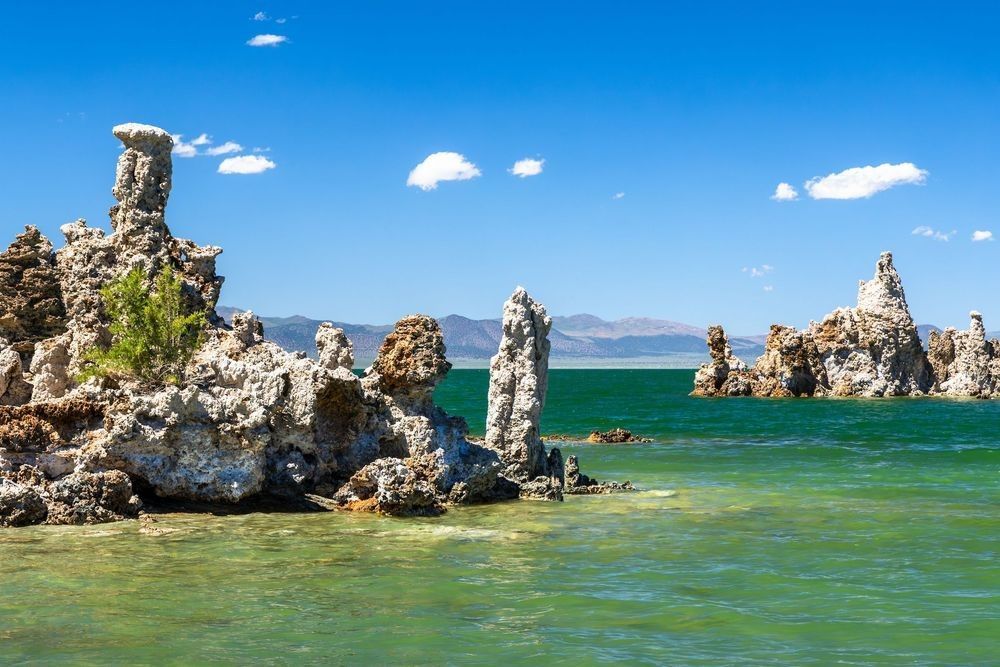
Dramatic tufa towers rise from Mono Lake’s aqua-green waters against a vivid blue sky — the South Tufa area gives you direct access to formations like these right at the water’s edge. Click the image to view print options.
The Western Area: More Space, More Solitude
A short drive west of the main South Tufa entrance, there’s a second cluster of formations with free parking and a noticeably different feel. Fewer people, less-defined trails, and a wider sense of open space. I had most of this area to myself, which after the busier main area felt like a completely different experience.
This is where I found the sandy beach — a broad, white stretch of shoreline with California gulls scattered across it and tufa towers rising behind them against the blue sky. That combination gave me a different compositional vocabulary than the main area: instead of tight shots of the formations alone, I could work with the birds as foreground interest and the tufas as backdrop, with the snow-capped peaks of the Sierra Nevada visible on the horizon beyond. Some of the images I’m most excited about from this shoot came from this spot.
The trails out here are less worn but perfectly walkable. Worth the extra few minutes to drive over and explore — particularly if you want photographs without other visitors in the frame.
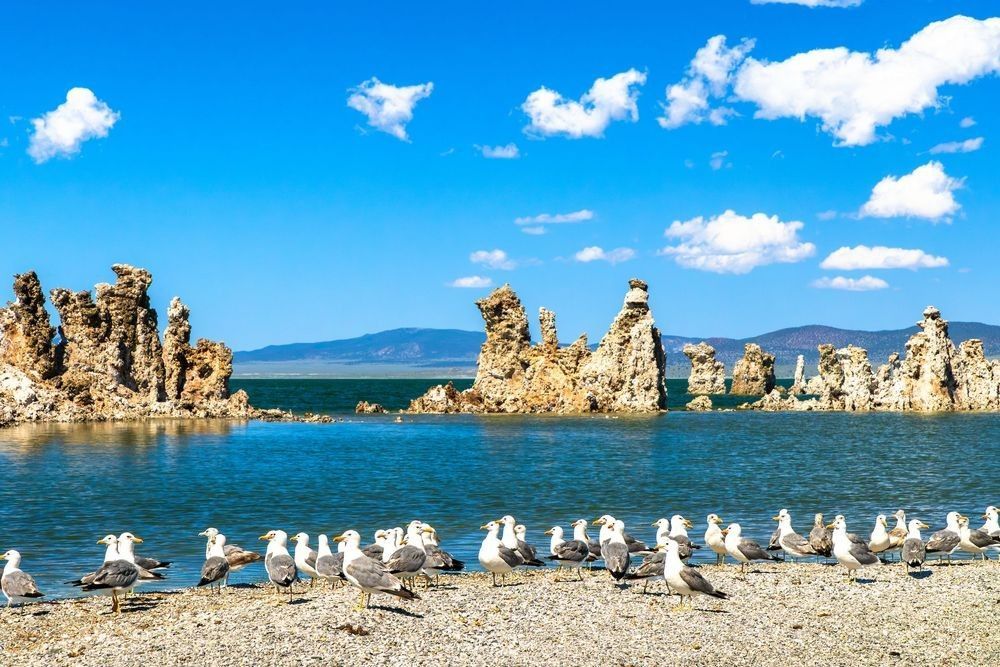
California gulls gather along the shoreline at the western free parking area — tufa towers rise behind them with the aqua-green lake and distant mountains beyond. Click the image to view print options.
Wildlife: Gulls, Alkali Flies, and the Ecology of an Extreme Lake
One of the first things you’ll notice walking near the shoreline is the alkali flies — black clouds of them lifting off the ground as you approach. It sounds alarming, but it’s actually one of the more remarkable things you’ll see at Mono Lake. These flies are specially adapted to survive in the lake’s harsh alkaline environment, and they’re a cornerstone of the entire ecosystem. The brine shrimp play a similar role — thriving in conditions where almost nothing else can survive. Together, the flies and shrimp sustain the enormous bird populations that make Mono Lake one of the most important migratory stopovers on the Pacific Flyway.
The California gulls are impossible to miss. Between forty-four thousand and sixty-five thousand of them nest at Mono Lake each year, primarily on the lake’s islands, which are free of the coyotes and other predators that would decimate ground-nesting birds on the mainland. The water diversion story intersects here too: as the lake level dropped, Negit Island — one of the main nesting sites — became connected to the mainland by a land bridge, exposing the nests to predators and threatening the colony. The partial water restoration that began in the 1990s has helped restore that separation, but it remains an ongoing concern.
The lake is too alkaline and saline for fish — none live in it — and that same chemistry makes it undrinkable for the birds. What sustains them for drinking water are the freshwater streams flowing in from the Sierra Nevada. About a mile from the tufa area I could see what I believe was Lee Vining Creek entering the lake, and watching the birds move between the formations, the shoreline, and that fresher water gave a quiet sense of how interconnected the whole system is. The osprey nest visible from the main boardwalk area is another reminder that Mono Lake is a complete, functioning ecosystem — built on extremes, but functioning.
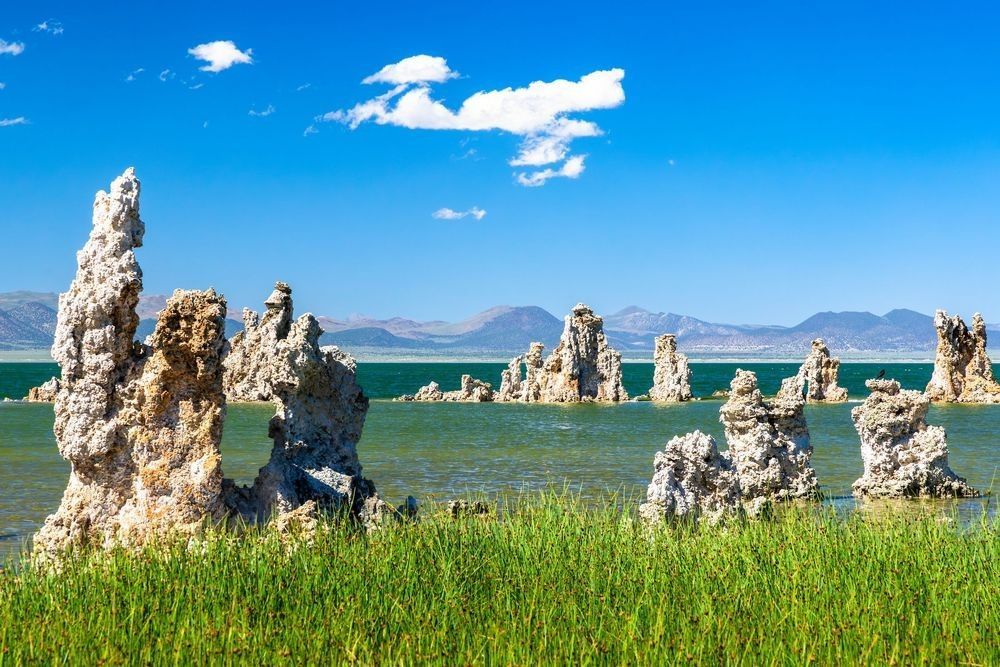
Tufa formations and lush shoreline grasses at Mono Lake — the unique alkaline ecosystem supports brine shrimp and alkali flies, which in turn sustain tens of thousands of migratory birds each year. Click the image to view print options.
Photography Notes: Midday Light, a Polarizer, and a Lesson I Keep Re-Learning
I arrived at around one-thirty in the afternoon — not the hour most landscape photographers would choose for a location as photogenic as Mono Lake. I’ve shot here before at sunset, and that light is genuinely extraordinary. The images from that earlier visit, made with a Canon 5D Mark II, are ones I’ve been proud of for years. This visit was different by necessity: midday or skip it entirely.
What made the shoot work was a circular polarizing filter. The conditions at Mono Lake that afternoon — bright midday sun, white puffy clouds, and the lake’s intensely blue alkaline water — are close to exactly the situation a polarizer was designed for. It cut through the glare on the water’s surface, deepened the blues dramatically, and made the clouds pop against the sky in a way that added real drama to frames I might otherwise have dismissed as too flat. Against the stark white of the tufa towers, that saturated blue is already a striking palette. The polarizer pushed it further. I don’t reach for a circular polarizer on every landscape shoot — there are situations where it works against you — but at Mono Lake in midday summer sun with reflective water in the frame, it’s transformative.
I shot mostly at f/16 to hold focus across the full depth of each scene — foreground tufas, mid-ground formations in the water, and the distant Sierra peaks all in the same frame. I was handheld at 1/200th of a second, with ISO varying as conditions changed. A tripod would have given me more precise control over composition, especially for the wider scenes with the snow-capped mountains in the background, and I’d recommend bringing one on a planned shoot. It wasn’t essential for what I was going for, and the images held up well handheld at those settings.
One unexpected element worth mentioning: there was yellow pollen floating on the surface of the lake near both tufa areas. I’m normally not a fan of pollen in water — we see a lot of it at Tahoe and Donner Lake, and it usually reads as a distraction in the frame. At Mono Lake, set against the electric blue of the water and the white of the tufas, it became something else entirely. A warm, golden foreground layer that added color contrast and visual depth to the composition. I leaned into it rather than working around it, and some of those frames are among my favorites from the session.
The larger lesson — one I keep learning and re-learning — is captured in a saying usually attributed to the legendary photojournalist Weegee: f/8 and be there. The point isn’t the aperture. It’s that showing up is the variable that matters most. I wasn’t there at golden hour. I wasn’t there for a planned shoot with pre-scouted compositions. I was there because I took a turnoff on a drive home and had my camera with me. The polarizer did its job. The rest took care of itself.
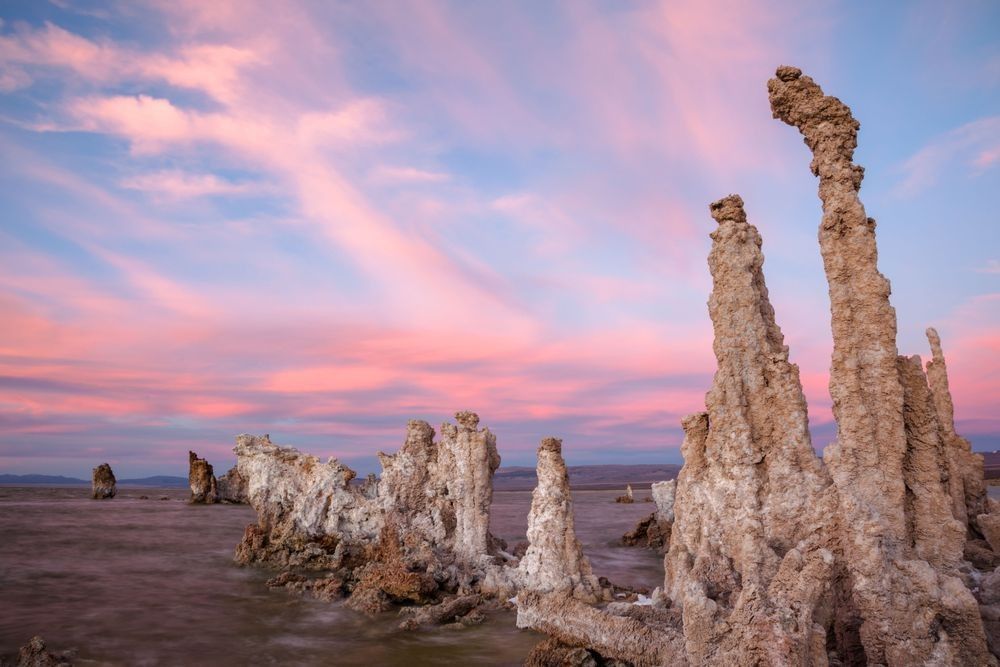
Mono Lake at sunset — photographed on a previous visit, this golden-hour light shows the same tufa formations in a completely different mood than the midday session. Click the image to view print options.
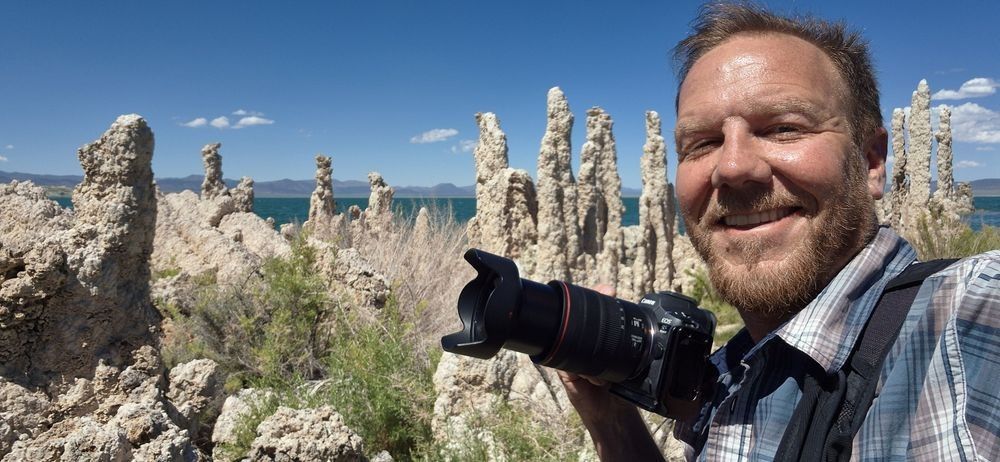
At the South Tufa area with the Canon R5 Mark II — midday light, circular polarizer, and a last-minute decision to pull off the highway.
Before You Go: Practical Details
Download your map location before you lose signal. Cell coverage along Highway 395 near Mono Lake is weak — I’m talking barely-there 4G at best. I got lucky that Google Maps loaded just in time to navigate me to the South Tufa parking area, but I wouldn’t count on it. Save the South Tufa area pin in your map app before you head out, and you’ll have no trouble finding it even with no signal.
Bring a hat. I forgot mine for the first area and regretted it almost immediately. The sun at Mono Lake is relentless — you’re in a high desert basin with full sky overhead and no shade. Hat and sunscreen are non-negotiable.
Bring water. The walk is easy, but it has a way of turning into an hour or more if you have a camera. I had water in my pack, and I was glad it was there.
Wear shoes you don’t mind getting dirty. The shoreline can be muddy and wet in spots. Nothing extreme, but worth knowing.
The entrance fee is three dollars, paid at a credit card kiosk. I didn’t see a cash option, so make sure you have a card.
Any vehicle can make the drive in. The access road includes dirt and gravel sections, but it’s well-maintained and suitable for regular passenger cars. No four-wheel drive needed.
Restrooms and a picnic table are at the main South Tufa parking area — a welcome amenity given that you’re a bit of a drive from the nearest services.
Check out the western free area. Beyond the main entrance zone, a short drive west leads to a free parking area with a different cluster of formations, a sandy beach, and far fewer people. It’s worth the extra few minutes.
The Photos: Available as Fine Art Prints
The Mono Lake images from this shoot — along with a selection from my earlier visit at sunset — are available as fine art prints through TruckeeTahoePhotos.com. You’ll find them in the Other Areas Gallery, which features photographs from locations beyond the Truckee–Tahoe basin.
The tufa formations — with their sculptural shapes, the intense blues of the lake, and the white and warm-ochre tones of the limestone — are the kind of subject that earns a large-format print. The detail and tonal range in these images reward scale; I’d encourage you to think bigger than your first instinct. Metal prints are particularly well-suited to images with strong color contrast and water in the frame — the luminosity they bring to those Mono Lake blues is something worth seeing in person. I have work on display at Art Truckee Gallery in Downtown Truckee if you’d like to see the print quality before ordering.
Browse the Mono Lake collection in the slideshow below, then head to the gallery for full print options and sizing:
Browse Mono Lake Prints in the Other Areas Gallery →
Scott Thompson is a fine art and commercial photographer based in Truckee, California. His work has been featured in Tahoe Quarterly, the Wall Street Journal, and Robb Report, and is available for purchase at TruckeeTahoePhotos.com and through Art Truckee Gallery in Downtown Truckee.